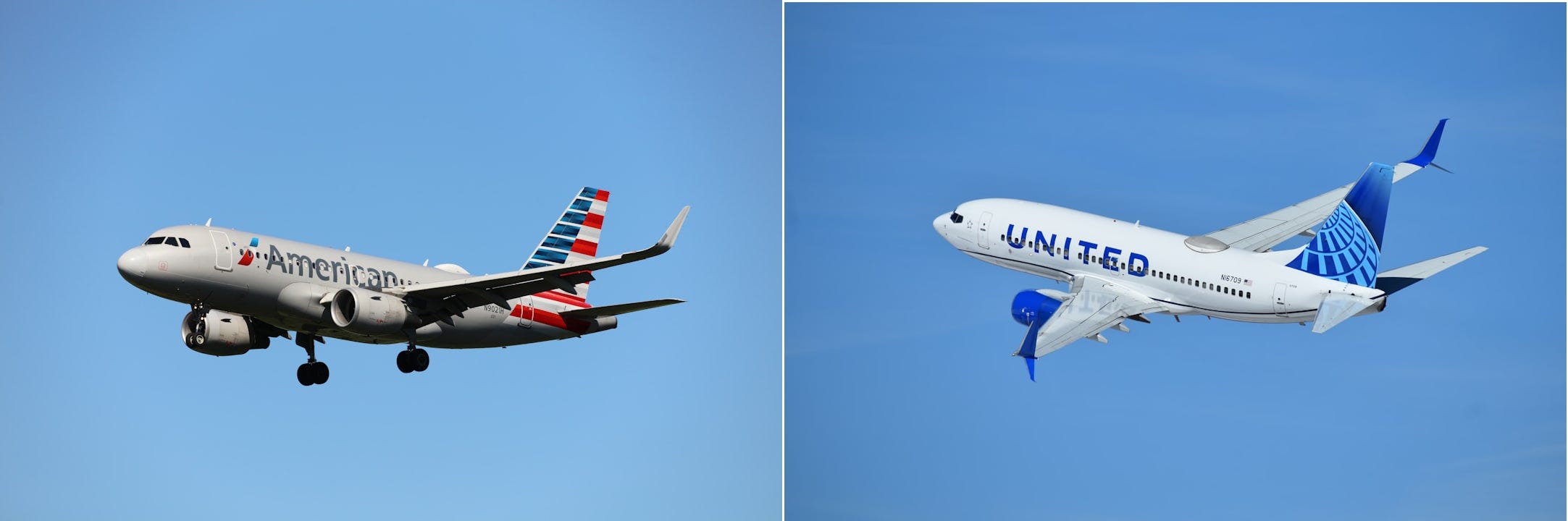
✈️ Could United Really Merge With American? Here’s What’s Actually Going On
A rumored mega-merger that would reshape U.S. aviation—if antitrust law didn’t stand in the way.
Hey everyone,
If you’re a frequent flyer, an investor, or just someone who pays attention to sky-high airfares, you probably saw the headlines this week. Bloomberg broke the story on April 13, 2026: United Airlines CEO Scott Kirby reportedly pitched a potential merger (or “combination”) with American Airlines directly to Trump administration officials back in late February.
The reaction was immediate. In one day, American's stock went up almost 8%. United rose a more modest 2-3%. Analysts called it everything from a “trial balloon” to “dead on arrival.” And for good reason.
Let’s break down what this rumor actually means, why it’s bubbling up now, and what it would (or wouldn’t) do to the skies we all fly in.
The Scale Would Be Historic
A United + American tie-up would instantly create the largest airline in the world by almost every measure:
Fleet: Roughly 2,874 aircraft
Annual revenue: North of $114 billion (nearly double Delta’s)
U.S. domestic market share:
By revenue passenger miles (the best measure of actual traffic, per latest BTS data through January 2026): ~34% combined (United 16.7% + American 17.4%)
By available seats / scheduled capacity (2025-2026 schedules, per OAG and analysts): ~40%
For context, the current “Big Four” (Delta, American, Southwest, and United) already control about 68-75% of U.S. domestic flying. This one deal would give a single carrier roughly the same slice that the entire legacy industry had two decades ago.
It would dominate major hubs and overlapping routes. Pre-divestiture estimates show the combo controlling 50%+ of domestic capacity at 159 U.S. airports. The combo would be massive in major cities like New York, Chicago, Los Angeles, Dallas, Houston, Miami, Denver, Philadelphia, and Washington.
Why Is This Coming Up Now?
Two big pressures:
Jet fuel prices are brutal after recent geopolitical shocks, particularly the U.S.-Israel-Iran conflict, which aligns with Kirby’s February meeting. Fuel is one of the biggest variable costs, and weaker carriers are feeling it more.
Profit gaps are widening. United and Delta are the clear profit leaders. America has been lagging (thin net income relative to its size). Kirby—who ironically helped engineer American’s 2013 US Airways merger when he worked there—has publicly said smaller/weaker airlines will struggle while the strong get stronger.
Transportation Secretary Sean Duffy recently signaled the administration sees “room for some mergers,” and Trump has historically loved big deals. So Kirby floated the idea. No formal talks appear to be happening, and both airlines and the White House have stayed silent.
The Antitrust Reality Check
Here’s where the dream (or nightmare, depending on your view) dies.
Experts across the board — from Cornell law professors to Wall Street analysts to consumer groups — say approval is extremely unlikely, even in a more business-friendly regulatory environment:
• Massive route overlaps (hundreds of city pairs where competition would drop to one or two carriers)
• Required divestitures would be enormous (gates, slots, entire routes)
• Labor unions, rivals (Delta, Southwest, JetBlue, etc.), and consumer advocates would scream bloody murder over higher fares and less choice
• One analyst said plainly: “I can’t even see the slightest chance that a court would allow it.”
Past mega-mergers (Delta-Northwest 2008, United-Continental 2010, and American-US Airways 2013) already consolidated the industry. The DOJ has taken a firm stance since then. A 30-40% domestic share would raise all possible concerns.
What Would It Mean for You, the Traveler?
If it somehow happened (a big if):
Short term: Chaos during integration, possible fare hikes on overlapping routes, but also potentially better international networks and loyalty program perks.
Long term: Less competition = higher prices on many domestic routes. Corporate travel managers would lose leverage. Disruptions (weather, mechanical) could cascade harder with fewer backup carriers.
But again, it’s not happening. This feels more like a strategy to create opportunities for future partnerships, or Kirby exploring options, than an imminent deal.
The Bigger Picture
U.S. airlines are healthier and more profitable than pre-2010, but the industry remains incredibly concentrated. The top four control the vast majority of capacity, while high fuel costs and capacity discipline have squeezed ultra-low-cost carriers (Frontier and Spirit).
Mergers can deliver efficiencies and better service on some routes — we’ve seen that. But they also reduce choice, and history shows much of the benefit flows to shareholders, not necessarily to passengers paying $400+ for a coast-to-coast ticket.
For now, the incident remains one of the biggest “what if” stories in aviation in years.
What do you think? Would you want a single mega-carrier dominating the U.S. skies, or does the current (already concentrated) setup feel like enough? Drop your thoughts in the comments—especially if you fly United or American regularly.
Safe travels,
EconWorks Observer
P.S. If you’re new here, I write about aviation, travel economics, tech, and big industry shifts with zero corporate spin. Hit subscribe for more deep dives like this (it’s free).
Sources for data: Bloomberg/Reuters reporting, U.S. Bureau of Transportation Statistics (RPM through Jan 2026), OAG schedules, analyst commentary from TD Cowen, Jefferies, etc. All public as of April 15, 2026.


